
Your Local Mortgage Lender
Located in Truckee, California
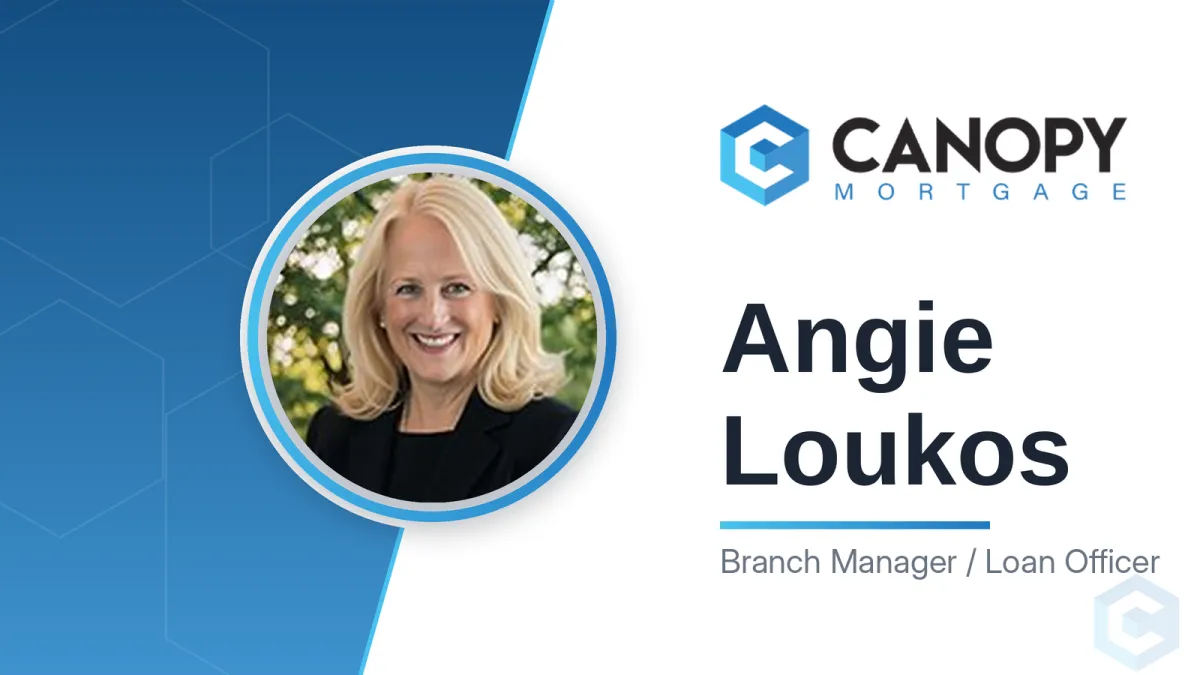

Angie Loukos
Branch Manager / Loan Officer | Canopy Mortgage
Residential Mortgage Loan Originator
NMLS ID #1398633
Over 40 years in real estate. 11 years as a dedicated mortgage lender. A foundation in real estate and construction that gives me a perspective most lenders simply don't have. That's the short version of what I bring to every client I work with.
My approach is built on one belief: a mortgage isn't just about the loan. It's about the life it makes possible. Your first home. A vacation place to make memories. A long-term real estate strategy that builds wealth for your family across generations. Each of these requires more than a rate quote. It requires a lender who actually understands the bigger picture. That's what I do.
Personalized Mortgage Experience
Angie Loukos offers personalized service and loan options you'll love. We shop multiple lenders to find the best rate and product for you, getting you into your dream home faster.
With wholesale interest rates and cutting-edge technology, we make the mortgage process seamless. Trust the experts who focus solely on mortgages. Support your local community and experience elite client service.
Let us help you achieve your homeownership dreams!
The Home Loan Process
Mortgage Pre-Approval
Get pre-approved from one of our Loan Officers to see how much you can afford.
House Shopping
Work with a trusted Real Estate Agent to find a home you would like to move into.
Loan Application
Complete your home loan application to get the lending process started.
Mortgage Programs
Experience the best mortgage experience located in California.
Home Loan Options
Our experienced mortgage advisors will walk you through the best mortgage loan program that will fit your specific scenario.
Conventional Home Loans.
FHA Home Loans.
USDA Home Loans.
VA Home Loans.
First Time Home Buyer
Jumbo Mortgages
Reverse Mortgages
HELOCs & Home Equity
LoansSecond Mortgages
100% Financing for Medical Professionals
Down Payment Assistance
Construction Loans
Renovation Loans
Buy Before You Sell Loans
Cross-Collateralization Loans
Non-Qualified Mortgage Loans
DSCR Loans
Bank Statement Loans
Profit and Loss Loans
1099 Loans
Non-Warrantable Condo Loans
Condotel Loans
Unique Property Loans
Farm Loans
Don't take my word for it
Frequently Asked Questions
How often can I refinance my mortgage?
There is no limit to the number of times you can refinance. However, you must qualify every time you apply and there will be costs associated with closing the loan each time.
Can I buy a home if I do not have money for a down payment?
Yes! There are a number of bond programs that offer low or no down payment financing options.
How do I know which mortgage is right for me?
The key to choosing the right mortgage is to understand the range of options and features available to you, as well as your budget, circumstances, and goals. Our licensed mortgage professionals are here to help you navigate that process. The more you know, the more comfortable and confident you will be choosing the best option for you and your family.
How long will the loan process take?
The Truth in Lending Act (TILA) does not permit a lender to close a loan until at least seven (7) business days have passed from the date your application was received. A typical home loan takes 30 days, as a number of third-party services such as appraisals, title work, and credit are required in conjunction with the mortgage process. Once you familiarize your Loan Officer with the details of your specific loan scenario, they will be able to provide you with a more specific timeline.
Will I qualify for a home loan?
The only way to find out is to speak with a qualified mortgage professional. Our Loan Officers have helped numerous clients who didn’t know if they could qualify to become home owners. We take the time to understand your financial situation and long-term financial goals, and then match you with the loan program that best fits your needs. Your approval for a loan may also largely depend on the price of the home you are financing. Getting pre-qualified prior to beginning your home search can give you an idea of what you may be able to afford.
Why do people refinance their mortgages?
Homeowners typically refinance to save money, either by obtaining a lower interest rate or by reducing the term of their loan. Refinancing is also a way to convert an adjustable loan to a fixed loan or to consolidate debts.
How much money will I have to pay upfront to buy a home?
This question does not have a simple, one-size-fits-all answer. The exact amount will depend on the price of the home you buy as well the type of mortgage financing you choose. Depending on your loan program, your down payment could be as much as 20% of the home’s price or as little as 3%, while some loans require no down payment at all.
Can I get a mortgage after bankruptcy?
You may still qualify for a home loan even if you have experienced a bankruptcy. The best way to find out if you qualify is to talk with a Loan Officer to discuss your options. Be sure to bring all paperwork regarding your bankruptcy so your Loan Officer can find the program that best fits your situation.
Should I lock my interest rate now, or wait until we are closer to our closing?
Interest rates fluctuate all day, every day. If an interest rate is good, it may be in your best interest to lock now. If you wait, you run the risk of an increase in rates later. If you are concerned that rates may go down after you lock, contact your Loan Officer to discuss your options. Some programs allow you to lock for an extended period and choose to lower your rate should a better one become available.
Most Recent Blog Updates

Should You Buy Now or Wait for Mortgage Rates to Drop and Here Is What Waiting Actually Costs
The Question Angie Loukos Hears Every Week and the Honest Answer Behind It
Buyers are waiting for rates to drop before they buy. Angie Loukos hears this consistently and understands the reasoning completely. But she wants buyers to think through what actually happens when rates fall rather than assuming the outcome will be as straightforward as it sounds.
What Actually Happens When Rates Drop
More buyers come off the sidelines. Competition increases. Prices tend to follow because more buyers competing for the same available inventory pushes values higher. The monthly savings produced by the lower rate can get partially or fully eaten up by paying more for the same house that was available at a lower price during the quieter period.
The negotiating leverage that exists right now when buyer competition is limited also disappears when the crowd returns. Sellers who are currently contributing toward closing costs, accepting price reductions, and funding rate buydowns will behave differently when they have multiple offers to choose from again. The concessions available in a lower-competition environment are not available in a high-competition one regardless of what the rate is.
The Flip Side of Higher Rates That Buyers Are Missing
Higher rates have produced a market condition that genuinely favors buyers in ways that are available right now and will not be when rates improve. Fewer buyers competing means more room to negotiate on price. More sellers willing to cover closing costs. More leverage for a seller-funded rate buydown that lowers the monthly payment in a way that produces similar results to a rate improvement while keeping the current purchase price advantage.
If rates drop later refinancing is an option. You can refinance into a better rate after you have already bought at today's price and with today's negotiating leverage. You cannot go back and buy at today's price after waiting a year and watching prices respond to renewed competition.
Why Waiting Is a Bet and Not a Plan
Nobody knows exactly when rates will fall. Not Angie. Not professional economists. Not the person on TikTok who sounds certain about it. A home purchase strategy built around a prediction that nobody can reliably make is not a plan. It is a bet on an uncertain future while a concrete present opportunity goes untaken.
The better question is not when will rates drop. It is whether you can comfortably afford today's payment at today's rate on today's home. If the answer is yes the case for buying now rather than waiting is worth taking seriously. Waiting when the answer is yes is not patience. It is risk.
What to Do If You Want to See the Real Numbers
Send Angie Loukos a message and she will build both scenarios for you. What buying now looks like in real numbers. What waiting a year looks like in real numbers. Side by side with actual figures rather than assumptions so the decision is based on analysis rather than hope.
Sources
NAR.realtor
MortgageNewsDaily.com
FederalReserve.gov
ConsumerFinancialProtectionBureau.gov
Investopedia.com

Mortgage Calculator
See your total mortgage payments using the tool below.
Interactive calculators are self-help tools. All examples are hypothetical and are for illustrative purposes only
| Year | Interest | Principal | Balance |
|---|

State Licenses
WA #MLO-1398633
TX #1398633
FL #1398633
CO #100524013
CA #CA-DFPI1398633
NV #68407
MN
Copyright 2026. All rights reserved. Angie Loukos, Residential Mortgage Loan Originator NMLS #1398633 |
Equal Housing Opportunity | Equal Housing Lender
Canopy Mortgage, LLC | 360 Technology Court, Suite 200 Lindon, UT 84042 | 877-426-5500 | NMLS Consumer Access #:1359687. All loans subject to credit and property approval. Our privacy policy is here and our terms of use are here. State License Data: Here
Licensed by the Department of Financial Protection and Innovation under the California
